
The CTE TAC collaborates with CTE administrators, educators, and school counselors, to support students in Career and Technical Education (CTE). We have compiled useful resources to assist school counselors in their discussions with students, parents, and families and tools to help with day-to-day responsibilities. While not exhaustive, these resources may contain items that are outside your role. We welcome suggestions for additional categories, links, or resources to support your work further. Please share your recommendations with us at
Career and technical education (CTE) is an instructional area which includes applied academics, professional skill development, and technical skills training. In New York, CTE takes place in nearly all school settings and includes the content areas of agricultural education, business and marketing education, computer science education, family and consumer sciences education, health sciences education, technology education, and trade/technical education.
School Counseling and Career and Technical Education
School counselors and Career and Technical Education (CTE) educators can work together to provide students with comprehensive career guidance and support:
Understanding students
Counselors can help students identify their strengths and interests, while CTE educators can help students identify the skills and interests needed for success in different career fields.
Planning for the future
CTE programs can help students plan for their future by providing rigorous programs of study and curriculum, and by connecting students with the business community.
Introducing CTE pathways
School counselors can introduce students to CTE pathways and hands-on training, which can help students make connections between their classroom learning and the real world.
Postsecondary planning
CTE programs can help students with postsecondary planning and academic motivation.
Career awareness
CTE pathways can help students become aware of career options and make important contributions to the 21st-century economy.
Advocacy
School counselors can advocate for students in the postsecondary recruitment process, and ensure students have equitable access to college and career programs and information.
CTE offers rigorous programs of study, academic and career technical education curriculum, and connections to existing relationships with the business community. Through these linkages, CTE serves as an effective and comprehensive model for counselors to use as they assist students in planning for their futures. As you have conversations with your students regarding their future, below are some helpful CTE resources:
- NYS CTE Fact Sheet
- NYS Profile CTE
- NYS CTE Equity Fact Sheet
- What is CTE? - See the updated The National Career Clusters® Framework.
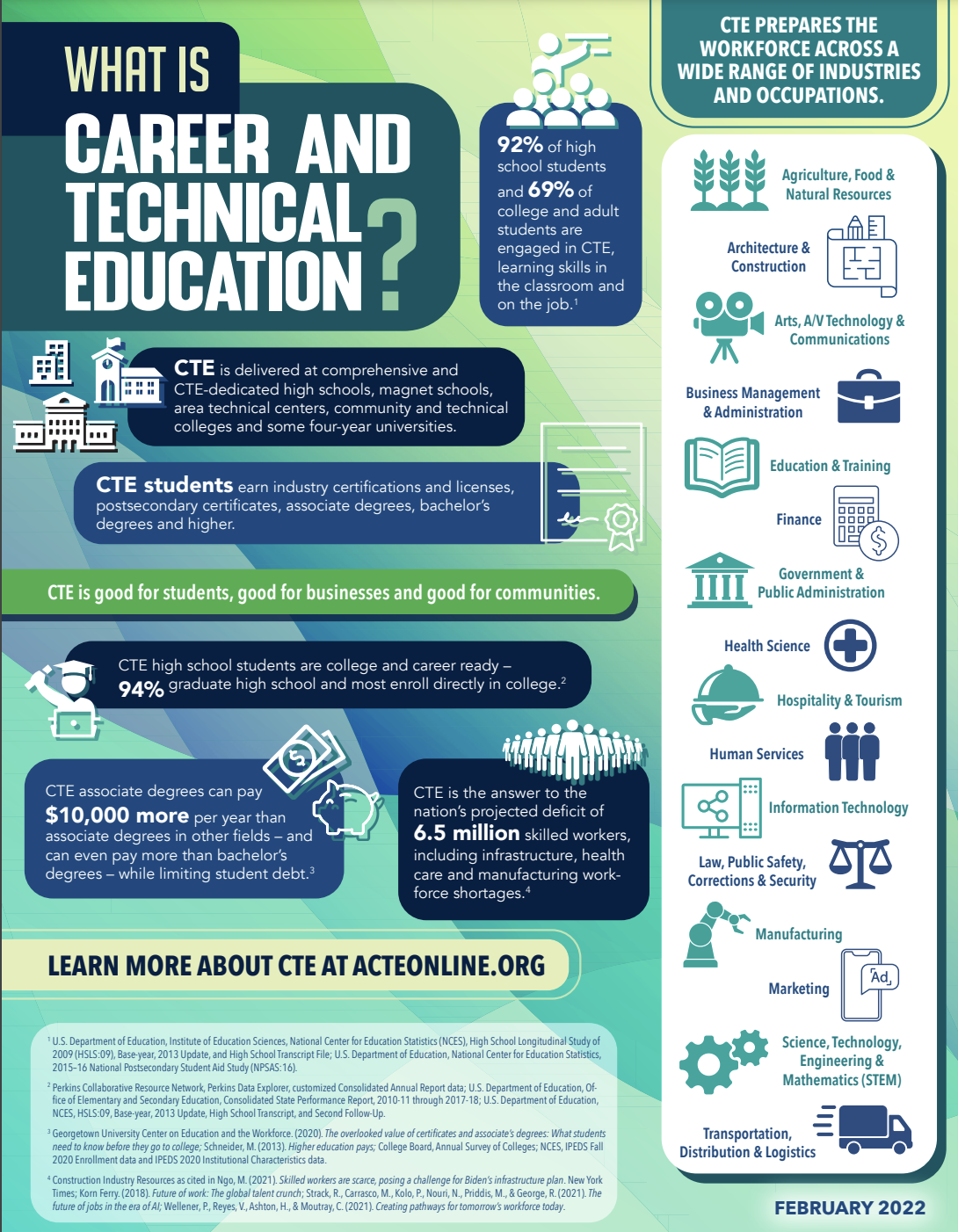
 What is Career and Technical Education?
CTE equips students with the technical, academic, and employability skills needed for success in the workplace and further education.
Why CTE?
New York is facing a skills gap: 49% of jobs require education beyond high school but less than a four-year degree, yet only 37% of workers are trained at this level. CTE programs can help bridge this gap, particularly in key industries with staff shortages that vary regionally. For more information on regional labor market trends see our Regional Occupational Projections Database.
What students should participate in CTE?
Career and technical education (CTE) is designed for all students, whether they plan to attend college or enter a skilled trade. CTE courses offer opportunities to:
- Prepare for the future: CTE helps students gain a better understanding of themselves, the world around them, and their role in it, enabling them to make informed decisions about their futures.
- Develop hands-on skills: Students can acquire practical, hands-on experience and industry-relevant knowledge through CTE courses. In addition, they develop career-ready skills that are applicable in all areas of work and advanced schooling.
- Explore areas of interest: Specialized CTE courses allow students to explore specific fields, giving them a preview of potential careers.
- Enhance college applications: Taking CTE courses can strengthen college applications, especially when aligned with a student’s intended major or career goals. Work-based learning builds upon this and may allow for college credits to give them a jump start in their college programs.
Benefits of CTE:
- The Association for Career and Technical Education has compiled quick, to-the-point informational resources to help you make the case for career and technical education.
- Students can use the 4+1 CTE Pathway to Graduation
- Students can earn academic credit
- Students can earn a technical endorsement on their diploma
- Schools can earn two points on the ESSA CCCRI for each endorsed diploma, click here for more information on ESSA
- The graduation rate for students who take a concentration of CTE courses is about 93 percent, approximately 10 percent higher than the national average
- NY CTE Fact Sheet
- What is CTE? - Association for Career and Technical Education
Economic Impact:
ACTE Sector Sheets describe CTE’s role in growing the qualified workforce for vital industry sectors. These sector sheets describe how CTE supports specific industries and prepares students for career success.